What Makes a Startup the Right Place to Build Your Career?

Only 34.7% of business establishments born in 2013 were still operating in 2023, according to the Bureau of Labor Statistics. That figure counts branches and single locations as well as standalone companies, but it is still a sobering number to hold next to an exciting startup job offer. It is a good reason to treat the decision as more than a gut call.
None of this makes startups a bad bet. The people who do well in them usually chose with a goal in mind: faster learning, a path into leadership, or a shot at equity. At Apron Systems, a leading recruitment firm in USA, we often meet candidates holding one steady offer and one risky one, with no clear way to compare them. This guide shows how to make that comparison.
How do you evaluate a startup against your career goals?
Evaluate a startup by checking whether its stage, the role, and the risk match what you want from the next two or three years. Pick one or two goals first, then test the company against them before you accept anything.
| If your goal is | A stage that tends to fit | Watch for |
|---|---|---|
| Learning fast across functions | Seed or Series A, with a senior person who will coach you | A team so small nobody can review your work |
| Deep expertise in one craft | A later-stage company with an established team in your field | Early roles where you are the only specialist |
| Moving into leadership | A growing team with a clear route to managing people | A big title with no budget or authority behind it |
| Steady income | A profitable or well-funded company paying near market rate | Pay that leans on equity that may never pay out |
| Equity upside | An early stage, a role close to product or revenue, and savings to wait | Being unable to afford your options if you leave |
Two goals can sit together. Four can’t. Few startups offer fast learning, steady pay, and equity upside all at once, and candidates who expect all three are usually disappointed wherever they land.
Why does the company’s stage matter so much?
Stage tells you more about the job than the company’s name or its latest funding headline. Even among early-stage startups, a seed team and a Series A team work very differently.
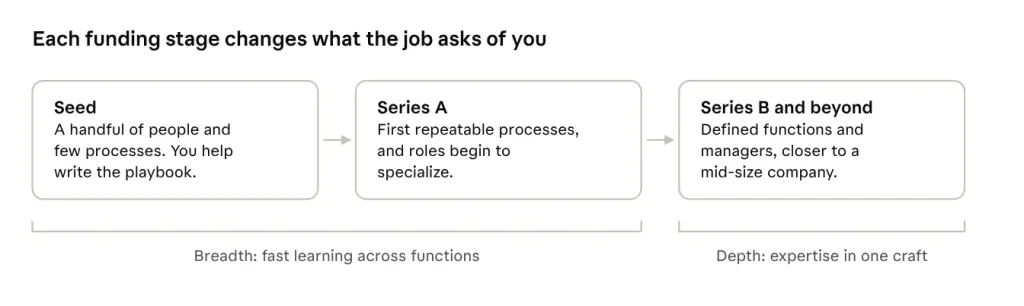
The earlier the stage, the broader the job; the later the stage, the deeper the specialty.
Funding patterns add context. In Carta’s Q3 2026 report, about one in four seed rounds raised so far that year was a bridge round, an extra top-up for a company that had already raised, and at Series C it was about one in five. A bridge isn’t a red flag on its own, but ask what the money was for.
Sector matters too. Hardware and engineering startups pay for equipment and materials long before revenue arrives, so ask how many months of funding are already in the bank.
What should you ask before accepting a startup job offer?
Ask about runway, the next funding round, revenue, and who has left recently, then check each answer against public sources. Most checks take an afternoon at most. We would rather a candidate ask the uncomfortable questions and walk away than skip them and face a layoff in month eight.
| Ask | Then check |
|---|---|
| Runway: How many months does the company have at its current spending? | A Form D on SEC EDGAR shows the offering amount and how much has been sold. Compare it with what you were told. |
| Next round: What did the last raise pay for, and was it a bridge? | Investor portfolio pages and press coverage show who backed the raise and when. |
| Revenue: Is it growing, and do one or two customers account for most of it? | Named customer announcements show where revenue sits. Compare them with what reporters say. |
| People: Has anyone senior left in the past year, and why? | LinkedIn shows headcount trends and how long senior staff stay. |
| Paperwork and timing: Can you see the offer, equity terms included, in writing? Is there a 24-to-48-hour deadline? | Nothing to look up. A refusal, or pressure that fast, is itself the answer. |
A single vague answer can be forgiven. Three in a row cannot.
How do you test the role, not just the company?
Ask what a successful first 90 days looks like and who would review your work. If the hiring manager describes three different jobs, you are being hired into a gap, not a role. In a ten-person company the reviewer may be the founder, which only works if the founder has time. Check the title as well, because “Head of” on a one-person team means far less than it sounds.
How do you check the hours and scope?
Ask what a normal week looks like and when the team last worked a weekend. Startup pace is rarely neutral, and our piece on what makes employees stay when work-life balance holds up covers the signals worth listening for.
On scope, a best hiring agency in USA pushes founders to spell out the job before a search starts, since a vague description attracts the wrong candidates.
Why should you treat equity as a bonus, not a salary?
Options are worth something only if the company succeeds and you can afford to exercise them. In a Carta analysis of 386 private companies valued above $1 billion, 82% had a median post-termination exercise window of 89 to 92 days. In practice, leaving often gives you about three months to buy your vested options with your own cash.
Before you put a number on the equity, ask:
-
What is the strike price? Compare it with the company’s latest valuation.
-
When was the last 409A valuation? A recent one is more reliable.
-
How many shares are outstanding? Five thousand options mean very different things in a company with two million shares and one with two hundred million.
-
Do investors get paid first? Preferred shareholders usually do, so a modest sale can leave little for employees.
How does a leading recruitment firm in USA help you vet startup roles?
A good recruiter reaches roles that never get posted, asks the runway and scope questions on your behalf, and tells you plainly when an offer doesn’t fit your goal. Founders often fill early roles through people they already trust, so a recruiter’s network can open doors a job board won’t.
Our job placement services in USA cover that groundwork across banking and financial services, healthcare, IT, and engineering and construction. Resume building matters more than most candidates expect when moving to a startup, because hiring managers look for ownership and results rather than a list of duties. We rework resumes around what you owned and what changed because of it, and our career counseling and interview preparation help you answer the “why us” question with specifics.
If the risk still worries you, contract roles are one way to test the work first. The best staffing agency in USA for that purpose is one that offers contract placements alongside permanent ones, so you can try a startup for a few months before committing. And the best recruitment agency in USA for your field will have watched how similar companies played out.
The bottom line
The right startup isn’t the one with the biggest funding headline. It is the one whose stage, role, and risk line up with what you want the next few years to give you. Write the goal down first, and every question above gets easier to answer.
If you are weighing a startup offer or building a shortlist, Apron Systems, a leading recruitment firm in USA, is glad to talk it through. We work across permanent hiring, contract staffing, executive search, bulk hiring, and job placement.
Frequently asked questions
1. Is working at a startup worth it?
It can be, when the stage and the role fit your goals. Startups offer faster learning and more ownership, along with a higher chance of failure, so check the funding, the scope of the job, and the equity terms first.
2. How do you know if a startup will succeed?
Nobody can know for sure, but growing revenue, paying customers, a recent raise with a plan for the next one, and low turnover among senior staff are good signs. Vague answers about runway are the strongest warning.
3. Should you take equity instead of salary?
Only if you can live comfortably on the cash and afford to exercise the options later. Treat equity as a bonus, and ask about strike price, share count, the latest 409A valuation, and investor preferences.
4. What should you look for in a startup job?
A clear scope, a named person who reviews your work, honest answers about runway, and pay and equity terms in writing. Match the stage to your goal: earlier for breadth, later for depth.