Work-Life Balance: What Makes Employees Stay With a Company?

More than half of U.S. employees are open to leaving their current employer. In Gallup’s employee retention data, 53% of employees said in August 2026 that they were open to leaving. Behind a number like that sit managers who can’t explain why good people keep resigning.
At Apron Systems, we hear both halves of that story. Employers ask why their teams keep turning over, and candidates tell us what made them start looking. Anyone searching for the best recruitment agency in USA usually has one of those two problems, and both lead back to the same question: do people feel their time is their own?
Why do employees really leave their jobs?
Most employees leave because of culture, engagement, and wellbeing rather than pay. Together, those two themes made up 68% of departures in Gallup’s 2024 exit data, while pay or benefits, the most common single reason, was named in only 16% of exits.
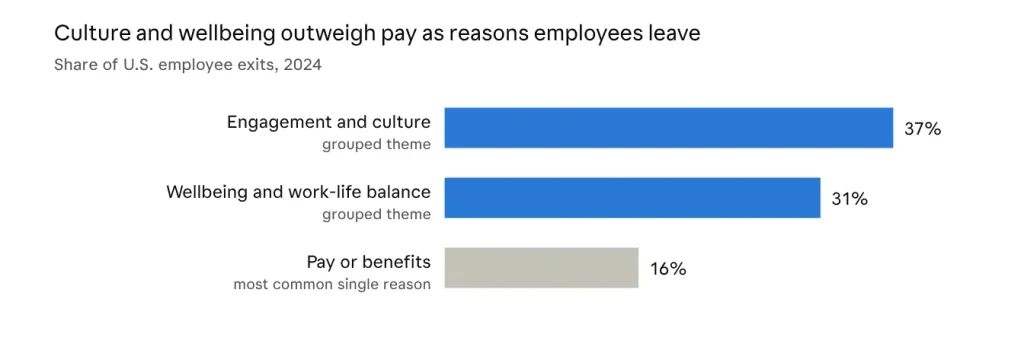
Pay still matters, since it usually gets someone to say yes. Looking ahead, though, 60% of U.S. employees in 2025 called better work-life balance and wellbeing very important in their next job. Job security followed at 57%, then pay or benefits at 53%.
Are employees actually quitting?
Far fewer than say they might. The Bureau of Labor Statistics’ JOLTS report for September 2026 counts 3.4 million quits, a quits rate of 2.1%, which means roughly 2 in every 100 workers left voluntarily that month. Intent to leave and actual resignations are two different things.
Many unhappy employees stay put because the market gives them little reason to move. That isn’t the same as being committed, and it is the part of the picture employers tend to miss.
What does work-life balance actually mean to employees?
For most employees, work-life balance means control and predictability, not simply fewer hours. They want to know when the workday ends, to carry a workload one person can realistically finish, and to handle a sick child or a dental appointment without a negotiation.
A game room or an unlimited-vacation policy rarely changes anything. If people don’t feel safe using the time, the policy is decoration. What works is less exciting:
- Shift and on-call schedules shared weeks ahead, not days
- Deadlines set around who is actually on the team this month
- A clear rule on after-hours messages that managers follow first
- Time-off requests approved without a debate
- Leaders who log off where the team can see it
None of this costs much. It needs someone with authority who means it. Recognition belongs in the same conversation, and we looked at it in our piece on how employee recognition supports a positive workplace culture. People who feel noticed get through the busy stretches with far less resentment.
Can taking away flexibility hurt retention?
Yes, and the people with the most options tend to leave first. University of Pittsburgh researchers tracked more than 3 million technology and finance workers at S&P 500 companies and found “abnormally high” turnover after return-to-office mandates, along with harder hiring afterward, according to SHRM’s report on the study. Fortune’s coverage of the paper adds the details:
- Departures rose about 14% on average after a mandate
- Filling an open role took 23% longer
- Senior and highly skilled employees were the most likely to leave
None of this means everyone should work from home, and plenty of roles can’t. The lesson is about control. People react badly when something they planned their lives around disappears with little notice.
The cost lands on hiring too. Candidates now ask about flexibility in the first conversation, and a company’s track record travels fast.
How does work-life balance differ across industries?
Balance is a different problem in every sector, because the pressure comes from the work itself. A policy written for an office does little for a night-shift nurse or a site supervisor. The scenarios below are illustrative, not client cases.
| Industry | Where balance breaks down | What it looks like in practice |
|---|---|---|
| Information technology | Unpredictable on-call duty and an always-on culture | An engineer covers weekends, but the rotation gets reshuffled with a day’s notice. A published quarterly rotation and a day off after each shift would keep the same team intact. |
| Healthcare | Long shifts and late schedule changes | A hospital unit posts rosters 48 hours ahead, then changes them the night before. Posting four weeks ahead lets staff arrange childcare and cuts last-minute swap requests. |
| Banking and finance | Quarter-end, year-end, and audit crunches | Late nights in March are accepted as part of audit season. When that availability is expected all summer too, resignations follow. |
| Engineering and construction | Project deadlines, site travel, and overtime tied to the schedule | A crew hears on Thursday that Saturday is mandatory. Overtime planned around the project calendar and announced weeks ahead feels like part of the job. |
In shift-based work, a stable schedule and easy shift swaps often count for more than a remote option ever could. In knowledge work, most people will accept a hard stretch if it has an end date and a fair share of the load. What they resent is an open-ended one.
What should you expect from the best recruitment agency in USA on work-life balance?
Expect straight answers about hours, on-call duty, and team turnover before an offer goes out. Candidates read the signals closely anyway: how quickly a recruiter replies after hours, whether interview times keep shifting, and what a hiring manager says when asked about a typical week.
We treat those answers as information for both sides. Our job placement services in USA include telling candidates about a hidden on-call load or a team that has lost several people in a year. It is a less comfortable conversation than closing quickly, but it produces placements that last.
The same approach shapes permanent hiring in USA. A mismatched hire costs far more than a slightly longer search, so we ask clients about schedule realities before the search begins. It matters even more in executive search in USA, where senior candidates have the most options and ask direct questions about travel, autonomy, and expectations. Our guide on executive search versus traditional hiring explains when each route makes sense.
What can employers fix first?
Start with data you already have, and act on what it shows:
- Overtime concentrated on one team: check headcount before blaming the people. Contract staffing or bulk hiring can cover the gap while permanent roles are filled.
- One manager losing people faster than the rest: look at their scheduling and after-hours habits first, then coach or reassign.
- Exit comments that mention schedules: fix notice first. Post schedules earlier and stop last-minute changes, which costs nothing.
- Polite, vague exit reasons: have someone outside the reporting line follow up. A leading recruitment firm in USA hears the unfiltered version, because people tell recruiters things they leave off exit forms.
The bottom line
Pay opens the door. Predictable schedules, workloads that match what a team can finish, and flexibility that holds up in practice keep people in the building. Gallup’s exit data, the return-to-office research, and the candidates we speak with all say the same thing.
If your organization is losing people and can’t say why, or you are a candidate trying to read what a role will feel like day to day, Apron Systems is glad to talk. We work across permanent hiring, contract staffing, executive search, and bulk hiring, and the first thing we ask any client is how the schedule really runs. For most teams, the best staffing agency in USA is simply the one willing to ask.
Frequently asked questions
1. Is work-life balance more important than pay?
For many employees it is, once pay is reasonable. Pay gets someone through the door, while schedule and culture decide whether they stay past the first year.
2. Does good work-life balance mean working fewer hours?
Not necessarily. Demanding stretches are easier to accept when they are predictable, shared fairly, and followed by recovery time. Open-ended pressure and last-minute demands are what wear people down.
3. Can employers offer balance in roles that can’t be remote?
Yes. Remote work is only one form of flexibility. Schedules posted early, simple shift swaps, fair overtime rules, and notice of changes all count, and in shift-based jobs they often matter more.
4. How can a candidate judge work-life balance before accepting an offer?
Ask for specifics: what a normal week looks like, when the team last worked a weekend, and how long the previous person stayed in the role. Concrete answers are a good sign. Vague ones, like “we’re like a family,” deserve a follow-up. The best hiring agency in USA should be able to answer these before you accept.